How did you get into aquaculture and, from there, to IRTA La Ràpita?
I discovered aquaculture during my Master’s in Oceanography, while on placements at the French Research Institute for Exploitation of the Sea (IFREMER), and I went to Montpellier for specialised training. Afterwards I looked for a lab where I could do an internship that could lead to a PhD, and that’s how I got to Enric Gisbert, head of the Aquaculture Programme at IRTA La Ràpita, who had a funded project on aquaculture nutrition. The internship lasted six months, and the trial I carried out then became the basis for my thesis.
Your thesis was about Senegalese sole. What problem were you trying to solve?
In fish farms, a share of the sole develop deformities: twisted spines or depigmentation, white patches. These fish can’t be sold, and for the companies that’s a direct loss. There are several causes, and one of them is nutrition in the early stages of life. I focused on lipid nutrition during the larval period, both on the applied side, such as choosing enrichment products for live prey (the larvae’s first food) based on how well they are absorbed in the gut, fish growth and development, and a lower incidence of skeletal deformities, and on the basic side: the gene pathways involved in deformity and depigmentation.
What marked you most about your time at IRTA?
My training was built there: larval rearing, biochemistry, histology, molecular biology and, in the end, writing up and presenting results in publications and conferences. The technicians were an enormous help, and together with my thesis supervisors, Enric Gisbert and Maria J. Darias, as well as other IRTA researchers and researchers from other centres, we built a great team dynamic. I also had the chance to do research stays in other labs in Europe, and the academic output of my thesis was very productive.
After your thesis you crossed the Atlantic. How was the adaptation?
In 2016 I arrived as a postdoctoral researcher at the Centre for Research in Food and Development (CIAD) in Mazatlán, Sinaloa, Mexico. I swapped sole for shrimp and discovered the new field of genomics applied to aquaculture. Later I won a position at the Institute of Marine Sciences and Limnology of the National Autonomous University of Mexico (Imel-UNAM) to start a new line of research. But there was no lab or working facilities; everything had to be built from scratch, both the infrastructure and the collaborations, with the prospect of reaping the rewards only in the long term. Other opportunities came up in the State of Nayarit, closer to my family, and I decided to take them.
Aquaponics combines fish and plant farming in a single circuit: fish waste, transformed by bacteria, feeds the plants. How did you bring it to a community?
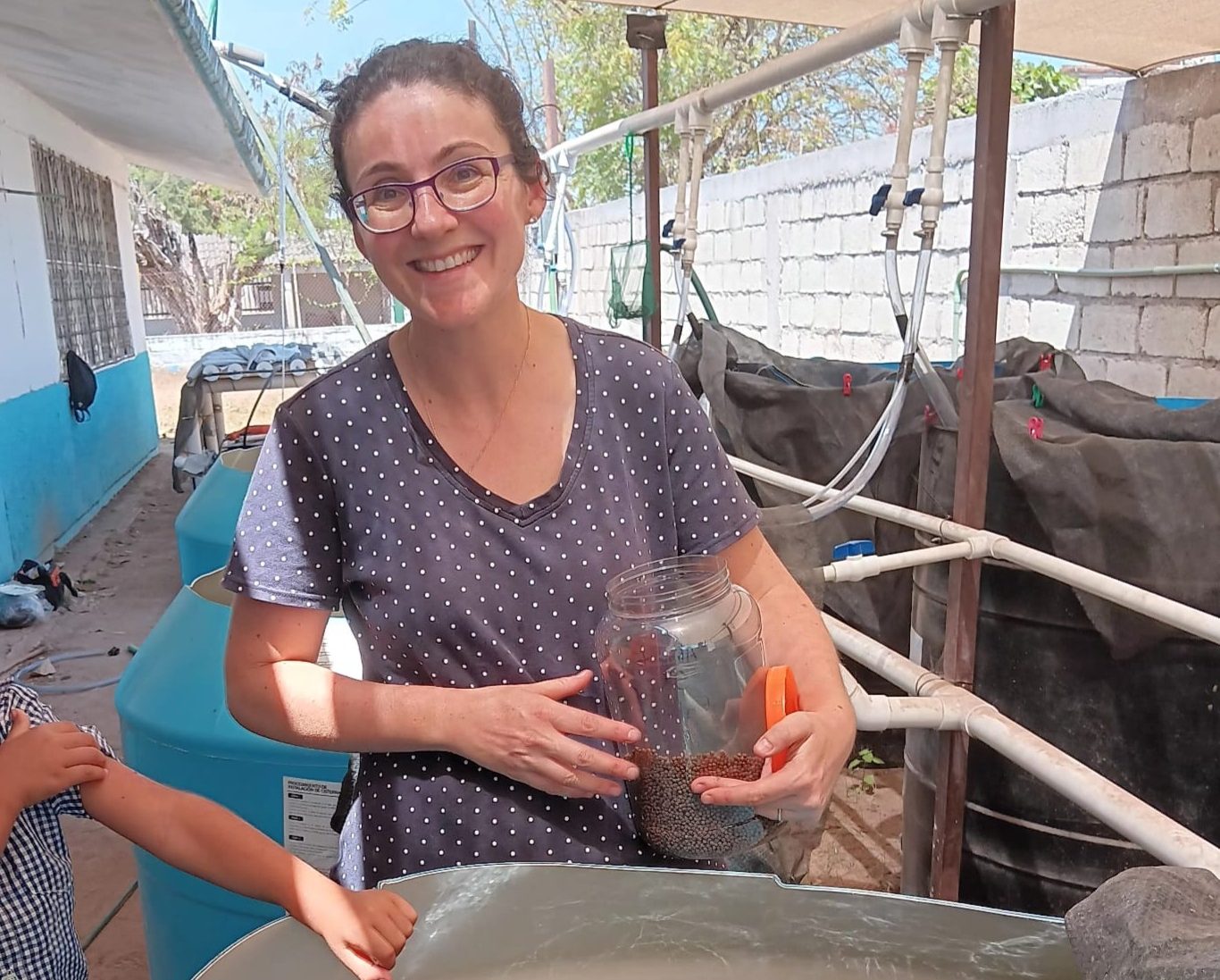
Agriculture in Nayarit is very traditional and uses a lot of agrochemicals. In other, more arid parts of the country, such as Baja California Sur (B.C.S.), it is hard to get fruit, vegetables and nutritious food for economically vulnerable populations. The project grew out of a collaboration between researchers at the Northwest Biological Research Centre (CIBNOR, La Paz, B.C.S., Mexico) and my team at the Autonomous University of Nayarit (UAN). We wanted to contribute to food security by reconnecting those who produce food with those who consume it. We installed an aquaponic module in a semi-rural nursery school for children aged 3 to 6, and trained their families and the teachers involved to run the system. The children fed the fish, and the vegetables and fish produced ended up in the school breakfast room. What we noticed most was the change in education: the children became very interested. When the funding ended, we couldn’t continue it.
Does this kind of work get the same recognition in the academic world?
No. The evaluation of academic output mostly values published scientific papers and graduated students, and gives very little weight to transferring knowledge to the social sector. But I believe part of a researcher’s job is making sure that what they develop reaches society, and I want to keep that line of work going in my current centre.
At CICESE you return to basic science. What lines of research do you have open?
I recently became a researcher in the Department of Aquaculture at the Centre for Scientific Research and Higher Education of Ensenada, Baja California. Here I’m developing lines of research around sustainable aquaculture systems: recycling the effluents they generate and using them to grow plants. With three students, we are working on recovering phosphorus from tilapia farming sludge to grow strawberries, on combining biofloc (an aquaculture technique that harnesses the communities of microorganisms living in organic matter and forming flocs, which serve as food and probiotics for the farmed organisms) with hydroponic lettuce cultivation, and on measuring whether the nitrogen released by an endemic tilapia species is enough to nourish chive plants.
And you also have an international project under way with IRTA.
Yes. Together with IRTA, CIBNOR, UAN and the Sonora Institute of Technology (ITSON), we have formed the binational Integrated Sustainable Aquaponics Network. The challenge is to make it easier to manage these systems in communities with high food vulnerability, where parameters such as temperature, pH, oxygen, nitrites and nitrates must be monitored to optimise the productivity of aquaponic crops, and thus contribute to food security, water justice and climate resilience in arid and Mediterranean areas. To that end, AQUAbox (INGESOM) has been developed, a smart monitoring system that will make it possible to compare how the systems perform in different contexts with different environmental conditions.
You have also taught and supervised students. What has that given you?
I taught students of the agrobiotechnology engineering degree at the Polytechnic University of the State of Nayarit (UPEN), in English and Spanish, for one year, and then every semester at postgraduate level at UAN. I learned to plan, to assess, and to come up with strategies for explaining difficult concepts through analogies. I have also advised, and still supervise, postgraduate students. I love helping them structure their project: formulating the scientific question to address a problem of interest, the hypothesis they want to test, and the methodology to do it. They often arrive with interesting ideas but little scientific methodology, and my job is to help them build a solid foundation for their project.
What advice would you give to someone finishing their PhD?
Experience abroad is very valuable for discovering new ways of working and other research topics. If you’re considering staying in academia, you should know that a researcher’s day-to-day work is largely management: writing proposals, managing and justifying financial and human resources, solving practical issues so you can answer scientific questions, and generating knowledge that is useful to society. It’s much more office time than lab time. So if what you enjoyed most about your thesis was the experimental part, it’s worth checking whether you like managing projects before deciding. And make the most of conferences to build international contacts and prepare postdoctoral stay proposals with labs where you’d like to work.