How was your first contact with IRTA?
My first contact with IRTA was through an internship during high school, in 2009. I spent two months at IRTA Mas Bové helping with research tasks in the monogastric animal nutrition laboratory.
After finishing my degree and master’s, I returned with a position as a laboratory technician in the Postharvest program. My first contract was from April to September, but my time there eventually extended to two years. I really enjoyed doing hands-on lab work, but I felt something was missing… I was always left wondering about the follow-up of the results I obtained. Then the opportunity to do a PhD came up, I secured funding, and joined the pathology group in the Postharvest program at IRTA Fruitcentre.
How do you remember your PhD years?
They were very good years professionally, but also personally. We were a large group and worked closely together, except for some tasks like data analysis or writing that I had to do alone—but you always had everyone’s support.
Among the PhD students, we also formed a very strong bond. Many of us were from outside Lleida, and we spent time together outside of work as well. We were people of similar ages sharing the same concerns and experiences.
I also have very good memories of my supervisors, Josep Usall and Charo Torres. At the time, Josep was the head of the Postharvest program and later became IRTA’s Director General during my PhD. With him, meetings were less frequent but very in-depth, while Charo provided more day-to-day guidance.
I also had the opportunity to mentor master’s and undergraduate students, which helped me learn how to supervise others.
What was your PhD about?
My PhD focused on brown rot, one of the most important diseases affecting stone fruit—peaches, nectarines, plums. It is caused by a fungus called Monilinia, and the main issue is that it attacks mostly during postharvest, when the fruit has already been picked and is being stored or distributed.
The thesis had two parts. The first was more practical: we wanted to understand whether light could influence how this fungus infects fruit. We studied nectarines exposed to different light intensities during storage—since fruit, from harvest to consumer, passes through many artificially lit environments such as packinghouses, trucks, and supermarket shelves. All this exposure could affect how the fungus develops, and that’s exactly what we wanted to understand. We also studied fruit that had been bagged during growth versus non-bagged fruit, to see if it influenced resistance.
In fact, the colleague who continued the work after my PhD went a step further and studied how different light colors affect the process, aiming to build scientific evidence on how all types of light influence harvested fruit.
Then, during a stay at the University of California, Davis, in the United States, I completed the second phase of my PhD. This consisted of a transcriptomic study analyzing how susceptible ripe and unripe fruit are to the fungus.
One interesting thing I learned there was silent work sessions. We would spend an hour reading or writing, then discuss it for 20 minutes, and then go back to reading. It was a great dynamic that I even brought back to IRTA on several occasions.
The United States wasn’t your only international experience. Where else have you been?
My first experience abroad was through Erasmus during my undergraduate studies. I joined a research group at the University of Antwerp in Belgium. They conducted very basic and in-depth research on Arabidopsis. What I saw there was a strong focus on precision and attention to detail.
After finishing my PhD, I did a fully international postdoc: 7 months in Patras, Greece, and 1 month in Limassol, Cyprus. There, I found research more similar to IRTA’s, but I was especially struck by the strong motivation to secure projects.
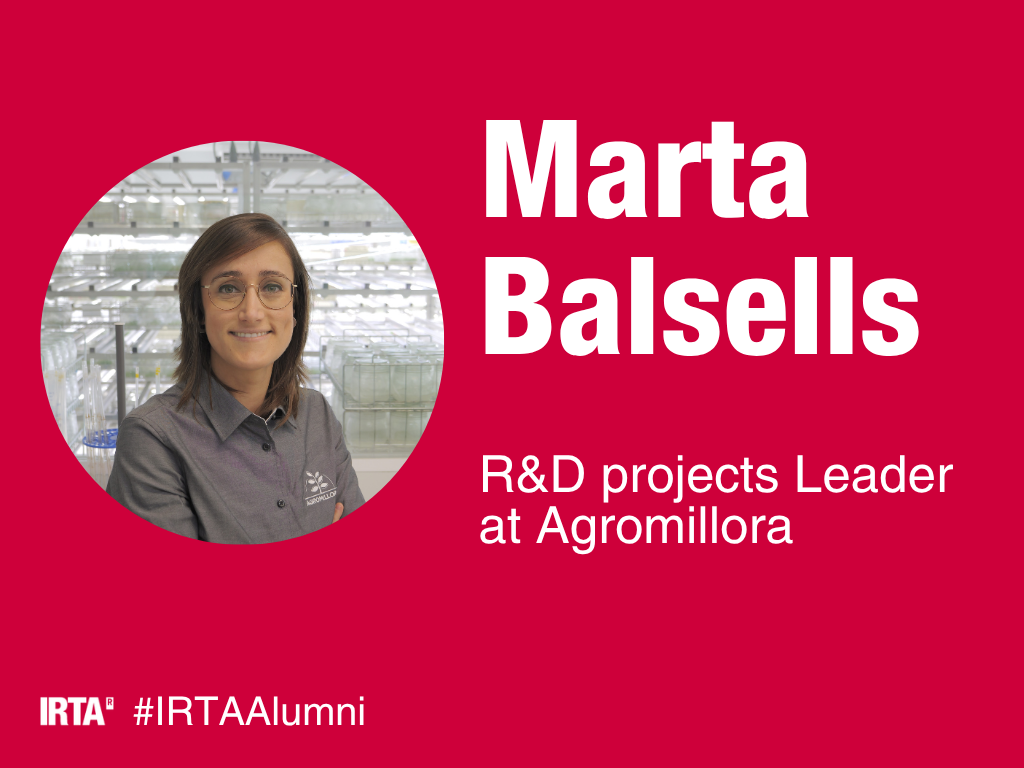
You’ve now been working at Agromillora for over two years. Can you tell us more about your current role?
Agromillora is an international company that produces and distributes mainly rootstocks—the lower part of the plant onto which varieties are later grafted. We work with stone fruit, olives, citrus, and recently, in some countries, berries. Everything except olives is produced in vitro, multiplying material clonally so that all plants are genetically identical to the mother plant.
When I joined Agromillora, I had two responsibilities: managing the corporate R&D laboratory and coordinating two research projects. The lab focused on in vitro culture, with a team of four people working on experimental varieties and species—everything still identified by codes, without commercial names—optimizing propagation for future commercialization.
Due to a corporate decision, the lab stopped being managed by Agromillora. From then on, I focused exclusively on research projects, which allowed me to take on more—now I coordinate five projects in collaboration with public research centers, applicable across the company’s global subsidiaries.
From lab bench to office—how have you experienced this transition?
It’s been very different. I used to combine both—lab work in the morning and office work in the afternoon. Now I’m always in the office, but it’s a new phase where I’m learning a lot and managing projects in ways I couldn’t before. It has really broadened my perspective.
Organization, people management, supervising students, working with audits, coordinating experiments—all the foundation I built at IRTA is what I apply every day now. Without that stage, I wouldn’t be able to do what I do today.
Finally, what skills do you think are key for doing a PhD at IRTA, and what advice would you give to someone just starting?
In terms of skills, I would highlight three. First, manual skills—lab work is very delicate and requires precision. Second, organizational skills, which are essential for managing lab tasks, writing, reading, meetings—everything. Third, interpersonal and communication skills, because there will be times when you are responsible for others—students, technicians—and you need to manage those relationships effectively, both with them and with your supervisors. I would add a fourth: patience and calmness. Sometimes, they are essential.
As advice, I would say: be sure that you truly enjoy research, and be prepared for a rollercoaster. There will be days when everything goes well and days when everything goes wrong. But you won’t be alone—you’ll have supervisors, colleagues, technicians, a whole environment that will support you. At IRTA, that support is guaranteed.